Loading...
Serving Marion, IL and surrounding areas. (618) 422-0172
Marion commercial buildings pay for poor insulation every month of the year. We assess, recommend, and install the right solution for your building type - starting with a free on-site estimate.
Commercial insulation in Marion, IL slows heat movement through your building's walls, roof, and floors so your HVAC system holds a stable temperature without running constantly, most straightforward retrofits for attics and wall cavities are completed in one to two days with your business open during the work.
A large share of Marion's commercial buildings were constructed in the mid-20th century, before the energy efficiency standards that exist today. If your building has never had a professional insulation assessment, there is a real chance the material in the walls or attic is insufficient, compressed, or missing in key areas. That gap shows up on your Ameren Illinois bill every single month. For buildings where the problem extends to gaps around the entire envelope, spray foam insulation can address both the thermal and air-sealing failure at the same time.
Marion sits in a climate zone that demands insulation perform in both directions - through genuinely hot, humid summers and cold winters. Buildings that were designed for one or the other, or that were never designed with insulation as a priority, pay for that every year in energy costs and employee comfort complaints.
If your monthly Ameren Illinois costs have been creeping up year after year - especially during Marion's hot summers and cold winters - your building is working harder than it should to maintain a comfortable temperature. When insulation degrades or was never adequate to begin with, your heating and cooling system runs longer and costs more. A noticeable rise in bills without a change in usage is one of the clearest signals that insulation is worth investigating.
If employees or customers regularly complain that one part of your building feels like a different climate from another, uneven insulation is a likely cause. In older Marion commercial buildings, insulation was often installed inconsistently - or not at all in certain wall cavities or roof sections. Hot spots near exterior walls in summer and cold drafts near loading doors in winter are both signs worth taking seriously.
Any place where outdoor air moves freely into your building is a place where your insulation system is failing. In Marion's climate, even small gaps become significant problems - they let in humid summer air that strains your cooling system and cold winter air that drives up heating costs. If you can feel a draft near an exterior wall or door frame, the insulation and air sealing in that area almost certainly need attention.
A large portion of Marion's commercial buildings were constructed before energy efficiency was a priority, and many have never been professionally evaluated. Insulation materials from that era can compress, absorb moisture, or simply fall short of what is needed to perform well in Southern Illinois's climate. If you do not know what is in your walls and attic, that alone is reason enough to find out.
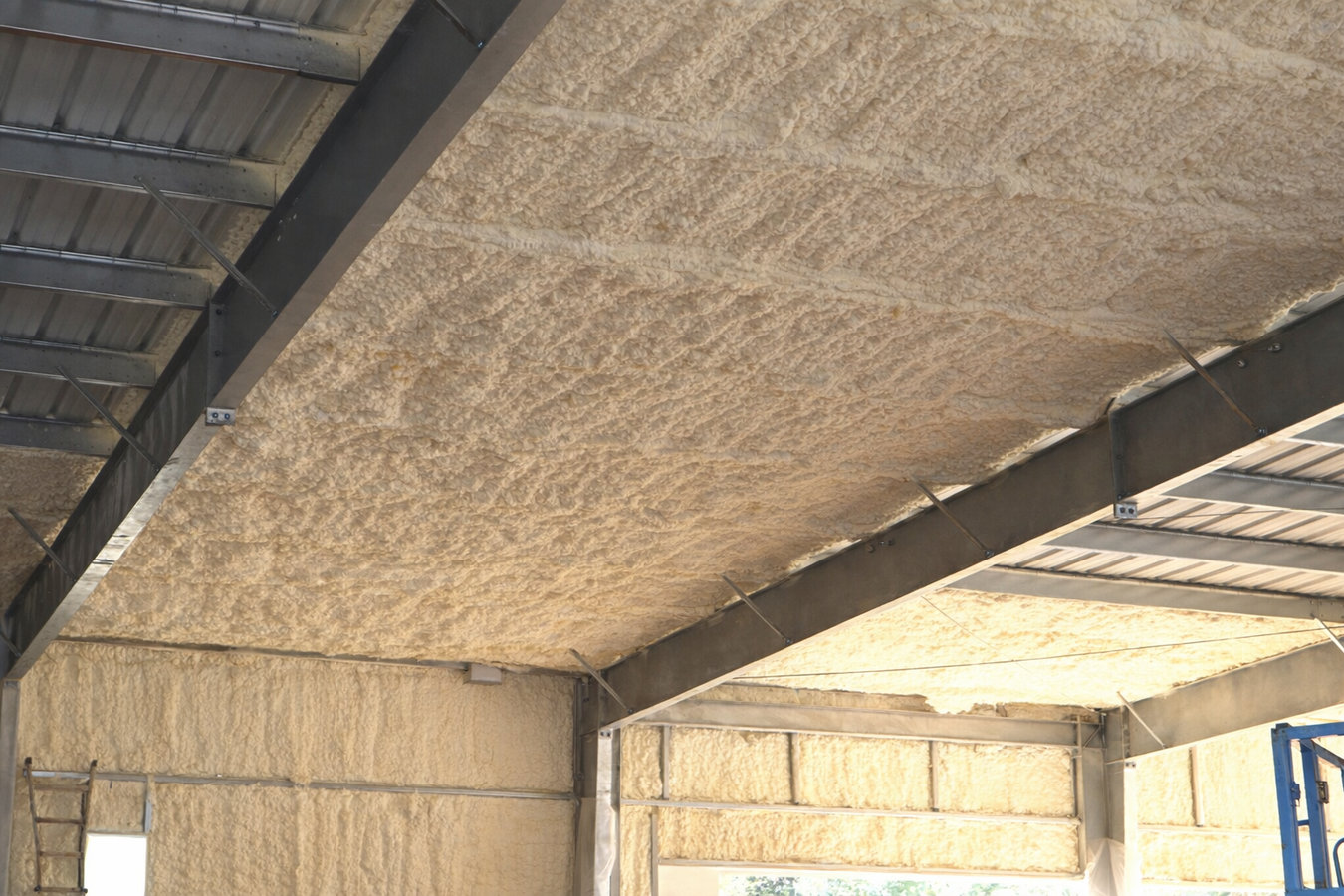
We install three primary types of commercial insulation based on what your building needs and where the insulation is going. Spray foam - including both open-cell and closed-cell varieties - expands to fill gaps and creates an airtight seal alongside thermal resistance, making it well-suited for roof decks, wall cavities, and rim joists. Rigid board panels are flat sheets installed against wall faces or under roofs, and they work well in new construction and in renovations where a continuous insulation layer is required by Illinois commercial energy code. For large attics and accessible cavities, blown-in loose-fill insulation is a cost-effective option that can be completed quickly with minimal disruption to your operations.
Many commercial projects involve more than one type. We frequently combine spray foam insulation for air sealing at penetrations and rim joists with blown-in material for large attic areas - getting the air-sealing benefit where it matters most and the cost efficiency of blown-in where the geometry allows. We also handle the vapor barrier work that goes alongside insulation in Southern Illinois's humid climate. For buildings with crawl spaces or below-grade areas, crawl space vapor barrier installation is often part of the same project scope. Every recommendation is put in writing so you understand exactly what is being installed and why before work begins.
Best for buildings where air sealing and thermal performance are both priorities - warehouses, metal buildings, and older masonry commercial structures.
Used in new construction and major renovations where a continuous insulation layer is required by Illinois commercial energy code.
Cost-effective option for large attic spaces and accessible wall cavities in commercial buildings where disruption to operations needs to be minimal.
Paired with insulation in Southern Illinois's humid climate to prevent moisture infiltration that degrades insulation performance over time.
Marion's commercial core includes a significant number of buildings constructed in the mid-20th century, many of which predate modern energy efficiency standards by decades. These buildings commonly have little or no wall insulation, degraded attic material, or both. Marion sits in Williamson County in Southern Illinois, where summer temperatures regularly reach the low 90s and the humidity makes moisture management inside the building envelope just as important as keeping heat in or out. Illinois also enforces a statewide commercial energy code based on the International Energy Conservation Code, which means significant renovations and additions must meet current insulation standards - your contractor should factor that into the scope and permit plan from the beginning.
We serve commercial customers throughout the Marion area, including building owners in West Frankfort and Benton, where similar mid-century commercial stock and the same Southern Illinois climate conditions apply. Ameren Illinois also offers energy efficiency rebate programs for qualifying commercial upgrades - it is worth confirming current eligibility before your project starts.
For energy savings estimates for commercial buildings, see the ENERGY STAR for Commercial Buildings resource. For general insulation guidance, visit the U.S. Department of Energy insulation guide.
We reply within one business day. In that first conversation we ask about your building's size, age, and what is prompting the call - high bills, a renovation project, or a general concern. From there we schedule an on-site visit at a time that works around your operations.
We walk your building and evaluate the current state of your insulation - checking the attic, wall cavities, roof deck, and mechanical spaces. We use thermal imaging where helpful to reveal gaps or missing insulation that are not visible to the naked eye. This visit is what allows us to give you an accurate estimate rather than a guess.
After the assessment you receive a written proposal covering scope, materials, timeline, and total cost. We also note whether a permit is required and who handles that process. Read it carefully and ask questions - a clear proposal protects both of us before work begins.
On installation day the crew sets up equipment, protects areas not being worked on, and gets started. Most work happens in attics, wall cavities, and roof assemblies that do not disrupt your daily operations. When the work is complete we walk you through what was done and coordinate any required inspection.
Free on-site estimate with no obligation. We reply within one business day and schedule around your operations.
(618) 422-0172We are familiar with Illinois's commercial energy code requirements and factor them into the project scope from the first estimate. Buildings undergoing significant renovations must meet current standards - we build that into the permit plan so you are not surprised by code requirements after the project starts.
We use thermal imaging cameras on commercial assessments to find gaps and missing insulation without tearing anything apart. That means our written estimates are based on what is actually in your building, not on assumptions - and you only pay for what your building genuinely needs.
We work with commercial building owners throughout Williamson County and the surrounding Southern Illinois communities. That local focus means we understand the mid-century construction methods common in this area and can spot the insulation gaps that repeatedly show up in buildings of this age and type.
Ameren Illinois offers commercial energy efficiency rebates for qualifying insulation upgrades. We stay current on program eligibility so we can flag opportunities before you sign a contract - giving you time to build available rebates into your budget rather than discovering them after the fact.
Commercial insulation is a long-term investment - most materials are designed to last the life of the building when installed correctly. Getting the assessment right before the work begins is the most important step, and it is where we put the most effort.
Ground-level moisture control for commercial buildings with crawl spaces - often installed alongside insulation in Southern Illinois's humid climate.
Learn MoreExpanding spray foam for commercial roof decks, wall assemblies, and rim joists where a combined air seal and thermal barrier is the priority.
Learn MoreMarion summers and winters do not wait - schedule your on-site assessment now and find out exactly what your building needs before another billing cycle passes.